






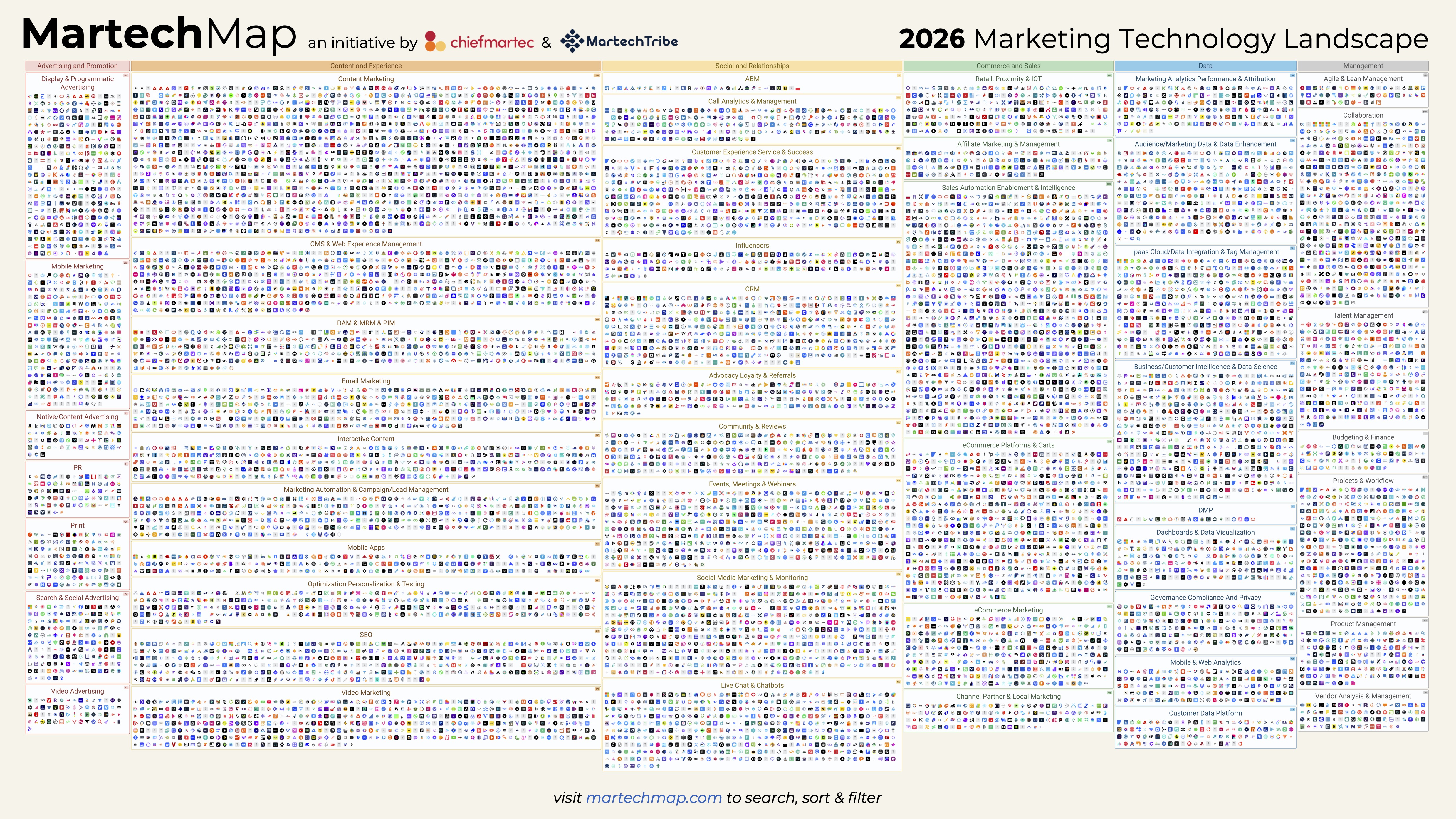
tl;dr The martech landscape effectively stopped growing this year, up just 0.79% to 15,505 products. After 15 years of relentless expansion, we may have finally hit peak martech — or at least a plateau.
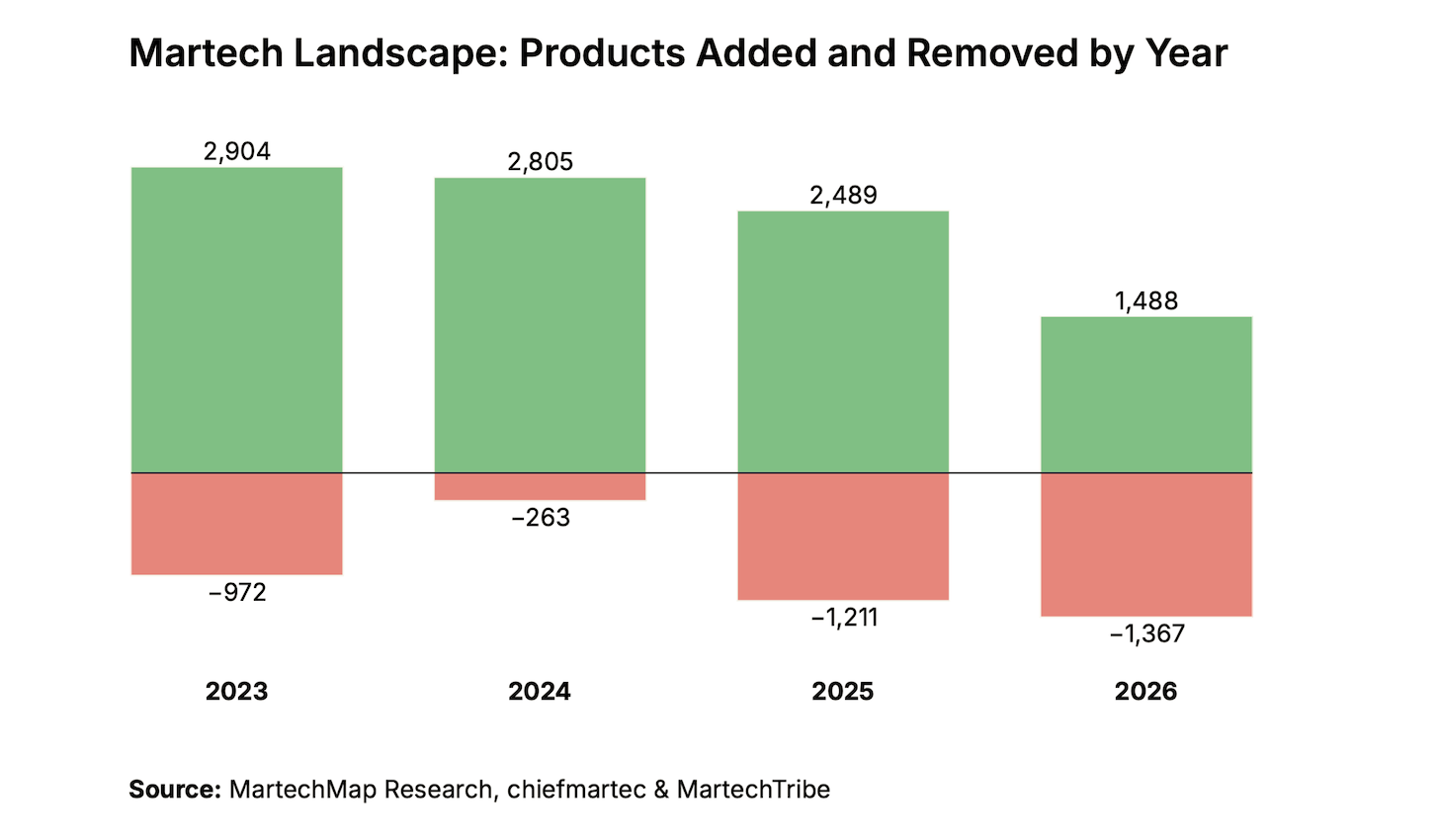
But underneath that flat headline, the market is churning fiercely: 1,488 products were added, while 1,367 were removed. Content marketing’s AI boom is already shaking out. CMS, ecommerce, analytics, integration, governance, and AEO/GEO are where growth is now accelerating. We cover all of this and more in our new State of Martech 2026 report — free and ungated.
For most of the past decade and a half, the annual martech landscape had a very predictable plot.
More.
More products. More logos. More categories. More existential dread for anyone trying to fit the whole thing on a single slide. Every year, the question was not would the landscape grow, but how much.
Some years it grew a lot. Some years it grew a merely ridiculous amount. Even in years when pundits confidently predicted consolidation was finally upon us, the landscape found another gear. Martech, like life in Jurassic Park, uh, found a way.
This year is different.
Which brings us to today’s release of the 2026 Marketing Technology Landscape, now with 15,505 products. Yes, it grew. Technically. Up from 15,384 last year, the landscape added a grand total of 121 net products. But that’s only 0.79% growth — effectively flat.
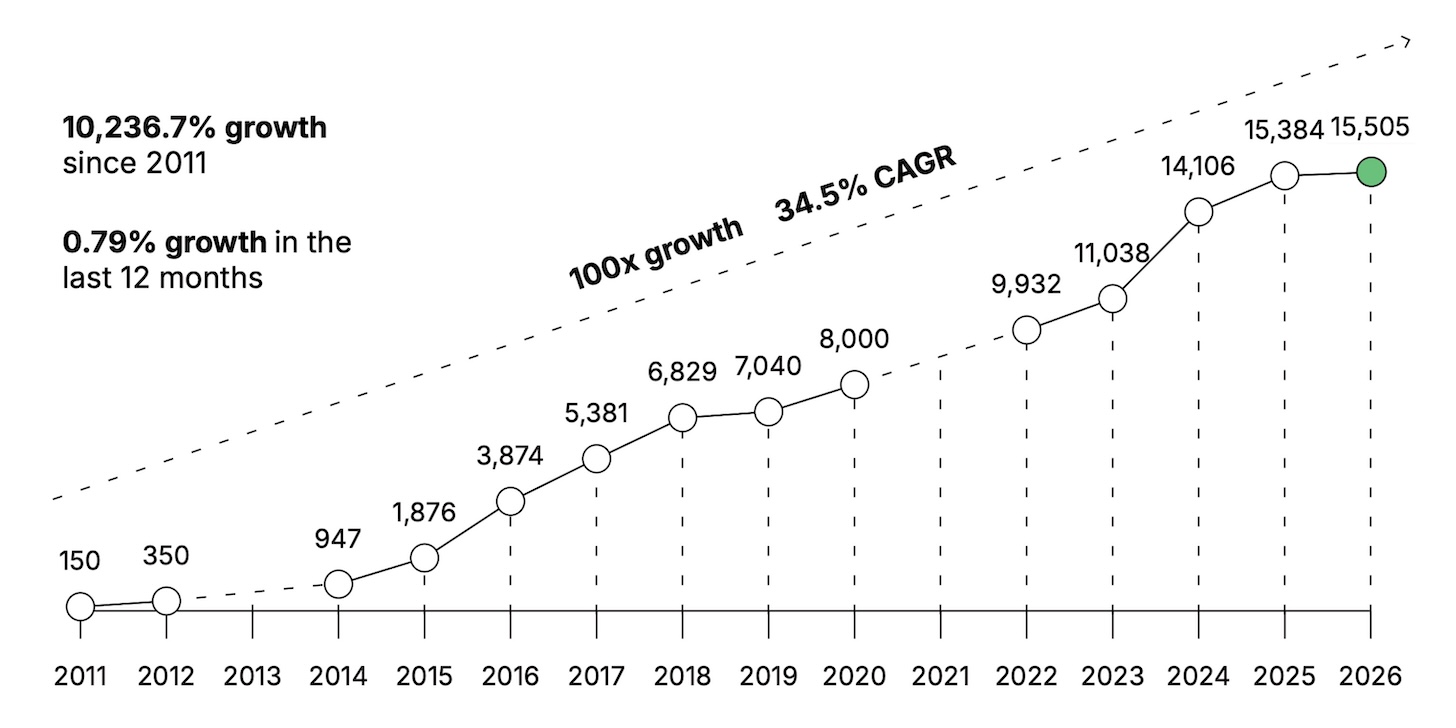
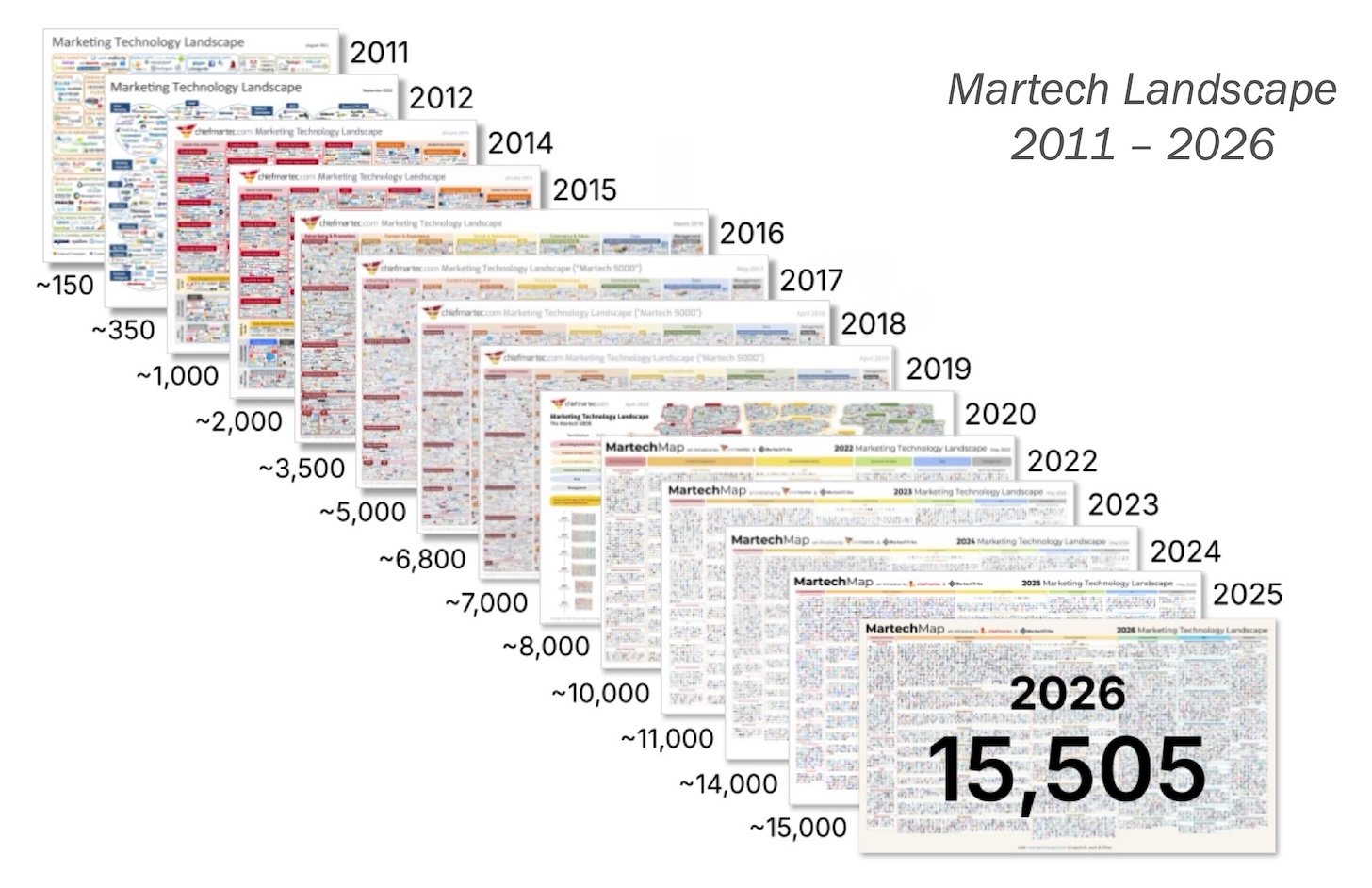
After 15 years of expansion from 150 products in 2011 to more than 15,000 today, we may have finally hit peak martech.
I know. We’ve heard that line before. Many times. Usually from people who then had to watch another thousand logos appear the following year. But this time, the data is at least willing to entertain the hypothesis.
Before anyone concludes that the martech market simply froze in place, let’s look at the flow.
Last year, 2,489 products were added to the landscape. This year, that dropped to 1,488 — a 40% decline in new entrants. At the same time, removals increased from 1,211 last year to 1,367 this year — up 13%.
So the reason the landscape barely grew is not that nothing happened. It’s that additions and removals nearly canceled each other out.
The largest cohort of the departed came from the 2010-2019 SaaS wave, accounting for 51.7% of this year’s exits. In other words, this isn’t just a bonfire of tiny AI wrappers launched during the first ChatGPT gold rush. A meaningful portion of the first great SaaS martech generation is now being cycled out.
The exits were also concentrated among smaller companies. By revenue, 45.5% of removed products were in the $1M-$10M range. By headcount, 41.2% had 1-10 employees, and 38.7% had 11-50.
These companies found enough traction to become real businesses, but not enough to become inevitable ones. And in a market where incumbents are bundling AI features from above, AI-native startups are attacking from below, and buyers are rationalizing what they already have, the middle gets squeezed.
Martech is a river, not a lake
But peak martech, if that’s what this is, does not mean the market has stopped innovating. The growth story this year is hiding in some very mature-sounding categories:
CMS & Web Experience Management grew 21.4%, from 504 to 612 products.
Ecommerce Platforms & Carts grew 19.9%, from 547 to 656.
These are not shiny new categories, but they’re seeing some of the strongest growth on the landscape because of AI.
For two decades, websites were built primarily for two audiences: humans and search crawlers.
Now a third audience is arriving: machines acting on behalf of humans — AI search assistants, agentic browsers, shopping agents, procurement agents, answer engines. They may not want to browse your site. They want to extract, compare, summarize, verify, and act.
The long-term headline is still astonishing: the martech landscape has grown over 100X since 2011 — 10,236.7%, for those who prefer their numbers with a dramatic number of digits.
But this isn’t only about serving external AI systems. AI is also making the on-site experience richer for human visitors. Marketers are deploying their own agents as guides, advisors, configurators, concierges, and sales assistants — powered by product data, content, customer history, pricing, policies, inventory, reviews, and brand guidelines.
That’s where context engineering becomes critical. The quality of the experience depends less on the model alone and more on what context the agent can access, what tools it can use, what actions it can take, and what guardrails govern it.
The ecommerce story follows the same pattern. Clean, structured, machine-readable catalog data helps external AI systems understand your products — and also powers richer on-site shopping experiences: AI concierges that compare options, explain trade-offs, assemble bundles, answer compatibility questions, and guide customers through complex decisions.
The future web experience may feel less like navigating pages and more like collaborating with a knowledgeable guide.
The rest of the fastest-growing subcategories rhyme with this same shift.
Mobile & Web Analytics grew 11.3%. Call Analytics grew 8.9%. As more customer journeys disappear into AI-mediated interactions, marketers are trying to instrument the parts of the journey they can still see.
iPaaS/Data Integration grew 8.0%. Governance, Compliance & Privacy grew 7.1%. When agents can act across systems, the connective tissue — and the rules governing it — matter a lot more.
Marketing Automation & Campaign/Lead Management grew 5.9%. Yes, that category. The one people have been declaring mature for years. Apparently, when AI starts changing orchestration, old categories get new plot lines.
The pattern is clear: AI is not only creating new categories. It is reactivating old ones.
More analysis in the State of Martech 2026
I’ve just touched on a few of the many findings and insights from the full State of Martech 2026 report, which is available to download, free and ungated.
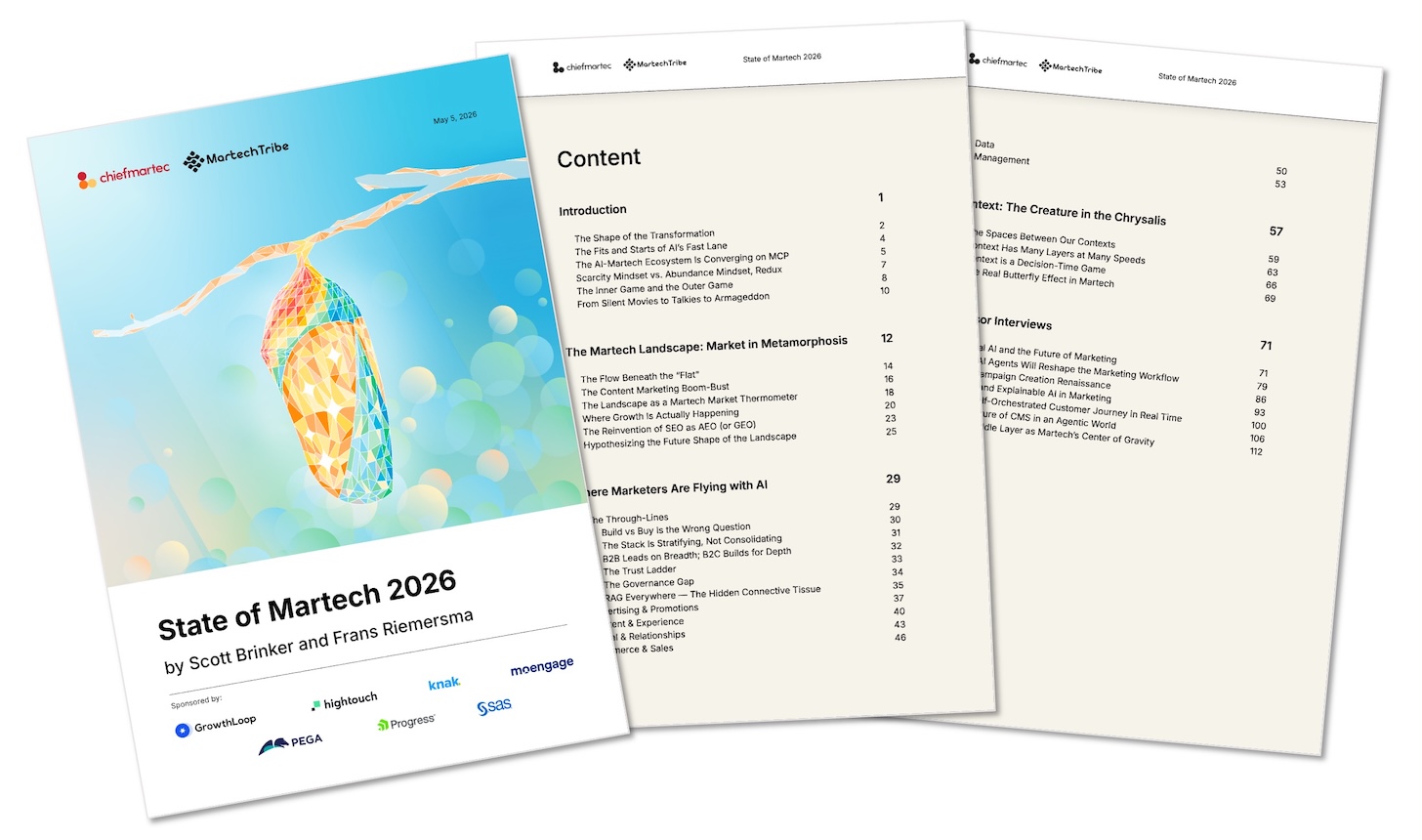
The report covers the complete 2026 Marketing Technology Landscape, our analysis of what’s happening across 15,000+ martech products, a deep dive into 70 AI use cases in marketing, and a chapter on context as the connective tissue of AI-powered marketing.
We want to thank GrowthLoop, Hightouch, Knak, MoEngage, Pega, Progress, and SAS for sponsoring our research and making it possible for us to share this report freely.
So yes, we may have finally hit peak martech. But these still waters run deep.
Download a hi-res, clickable PDF of the full martech landscape
Visit MartechMap.com to zoom, search, and filter the interactive version