







GEO has found its place in the search landscape, and it’s reasonable to think that the future of generative engine optimization is guaranteed. According to Datos’s State of Search report, Q4-2025 saw some interesting changes. For the first time, AI tools had a consistent 1.31% to 1.34% of visits in the U.S. In previous quarters and reports, traffic to AI tools was growing. This stability in traffic suggests that AI search tools may have found their place in the wider search landscape. ![Free AEO Grader: See Your Brand's Visibility in Answer Engines [Free Tool]](https://no-cache.hubspot.com/cta/default/53/d4233c10-60b6-46d7-9852-c71dde8507b6.png)
GEO is forcing a fundamental shift in how marketers think about inbound and loop marketing. As marketing channels multiply with AI search, Reddit, and new social media platforms, there’s a greater emphasis on cross-channel marketing. Marketers face the challenge of getting their content in front of audiences on every platform for every type of search. The struggles are especially prominent in GEO because it’s a new channel. While GEO builds on SEO principles, it also operates with some nuance. A channel with its own mechanics, signals, and reporting.
This guide will explore the future of generative engine optimization. Learn what’s changing right now, which generative engine optimization trends matter most, and how marketing teams can adapt with practical frameworks and tools designed for an AI-first search landscape.
Table of Contents
We’re in the future of GEO now.
Generative engine optimization (GEO) is no longer a forward-looking experiment. It’s already influencing how customers and prospects are discovering brands. AI tools have become a core part of how people research. Buyers are using large language models (LLMs) to shortlist vendors, compare options, understand technical concepts, and validate decisions before ever visiting a website.
At the same time, marketing teams are under pressure to produce the kind of structured, comprehensive content that generative engines prefer. AI copilots like HubSpot Breeze AI are increasingly being used to draft, expand, and refine content so it aligns with how LLMs interpret and synthesize information.
In practice, this means generative engines are shaping perception earlier in the journey. If a brand isn’t present — or isn’t accurately represented — inside those AI-generated answers, it’s invisible during critical evaluation moments, even if the SEO fundamentals are strong.
Why?
Because AI-generated answers frequently appear above sponsored placements and organic listings.
Plus, AI responses don’t simply summarize web pages. They answer long-tail, nuanced queries with contextual recommendations, filtering out noise and selecting the brands that best match a user’s specific intent. The goal for marketers is not to have their websites filtered out for the most relevant searches, and HubSpot’s Loop Marketing framework can help them do this.
Relevance, content structure, clarity of answers, authority signals, and consistency across the web and on a brand’s own site all play a role in determining whether generative engines choose to include — or exclude — a brand.
Taken together, these shifts signal a clear reality: GEO is not replacing SEO, but it is redefining where influence happens. Visibility now occurs inside answers, not just on websites.
Here’s a comparison table showing the key differences between SEO and GEO.
What forward-thinking marketers and SEOs predicted is now supported by evidence. The data leaves little doubt that generative engines are shaping the future of search (and inbound visibility).
HubSpot surveyed over 1,500 global marketers for its State of Marketing report. Marketers reported that while overall search traffic may be declining, 58% said AI referral traffic has significantly higher intent, with visitors arriving much further along in the buyer journey than traditional organic users.
I have found that AI referral traffic is significantly more likely to convert. One of my B2B clients illustrates this shift clearly. Their AI-driven referral traffic converts at 7.12%, compared to 1.37% from traditional organic search.
By the time a user clicks through to a website from an AI-generated response, they’re much closer to making a decision. Casual or exploratory queries are often resolved directly within the AI interface, whether that’s Google AI Mode, Claude, or ChatGPT, so clicks tend to happen only when a user is ready to evaluate options or take action.
As a result, AI referral traffic reflects deeper intent, more specific needs, and a higher likelihood to convert once it reaches a site.
The Future of Generative Engine Optimization
Here’s what’s changing and why it matters for GEO.
AI answers fulfill the discovery layer.
Generative answers are no longer a secondary feature in search; they’re increasingly the starting point.
Search generative experiences (SGE) such as Google AI Overviews and conversational tools like ChatGPT, Perplexity, and Claude now sit between users and the open web, shaping how information is discovered, interpreted, and acted on.
Rather than scanning search engine result pages (SERPs) and reading multiple articles to find answers, users are asking complex questions and receiving synthesized responses that significantly reduce research time.
The data supports this shift. Research shows that 60% of Google searches now end without a click, signaling that many informational needs are being fully satisfied directly on the results page or within AI-generated answers.
At the same time, click-through rates on informational queries continue to decline even as impressions and average positions remain stable, indicating that visibility alone no longer guarantees engagement.
Here’s an example where this is prominent:
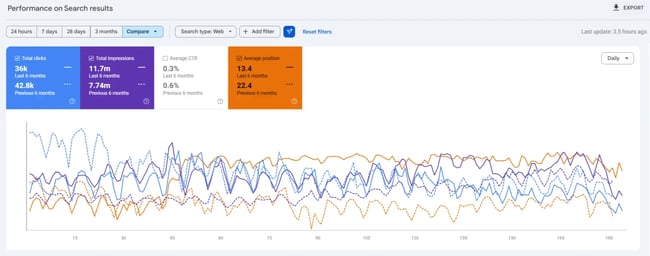
This website shows an improving average position in SERPs, yet clicks are decreasing. Further analysis shows that much of the content is top-funnel content; many pages that lost significant clicks include words like “what is,” “how long,” and “how to.”
In B2B specifically, AI as a discovery tool is growing. According to Inside the Buyer’s Mind, a Responsive report, 32% of B2B buyers report using generative AI chatbots to help inform purchasing decisions, often before visiting a vendor’s site. In practice, this means discovery is happening inside AI systems.
High-intent traffic is replacing high-volume traffic.
As a result of discovery and research taking place within AI, prospects arrive at websites later in the buyer journey already informed and ready to convert.
AI referrals tend to occur only when AI can’t resolve a query, and these queries tend to be decision-oriented needs such as vendor evaluation, pricing validation, or next steps.
Schema influences AI crawlers and maps entities.
Generative engines don’t rank pages based on keywords and links; they attempt to understand entities, relationships, and meaning across the web.
Structured data plays a critical role in that process. Schema has been shown to help pages gain visibility in AI systems like AI Overviews. In theory, schema should help AI systems identify what a page is about, how concepts relate to one another, and when a source is authoritative enough to be referenced in an AI-generated answer.
Early schema testing by Molly Nogami and Ben Tannenbaum found that a page with well-implemented schema surfaced in AI-generated results and also performed best in traditional search. By contrast, pages with weak or missing schema did not appear in AI Overviews at all.
Here’s what the well-implemented schema looked like in Google Search Console (GSC):
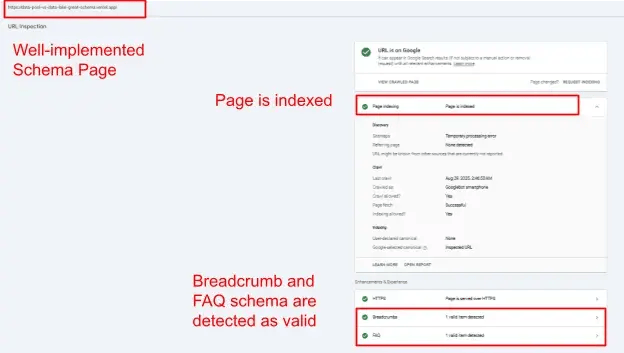
In practice, this aligns with what many SEO and content teams are already observing. Content that is easy for machines to interpret through structured headings, explicit answers, and schema markup is more likely to be reused by generative systems. Schema isn’t just a technical enhancement anymore; it’s becoming a foundational layer for GEO, enabling AI crawlers to accurately map who a company is, what they offer, and when their content deserves to be included in synthesized answers.
Citations and visibility replace clicks.
In generative engine optimization, marketers can’t measure clicks because searchers aren’t clicking through to websites to reach search results; instead, brand references and citations are metrics that replace visibility.
Both are, to some degree, vanity metrics, because they’re difficult to tie to business objectives. Visibility doesn’t make a sale within a session, but it does build awareness; the same was true for top-funnel SEO content.
Because of this, measurement is evolving. Instead of focusing solely on sessions and conversions, teams are beginning to track inclusion in AI answers, citation frequency, and competitive presence. Platforms like xfunnel help quantify these signals, giving marketers a clearer view of how their brand performs across generative engines.
Third-party credibility is key.
Generative engines place significant weight on how others describe a brand. It’s not just about how a marketing team presents its own brand. AI systems synthesize information from reviews, analyst commentary, media coverage, directories, forums, and social platforms to form a consistent understanding of who a brand is and what it’s known for.
When external sources describe a company in the same way, it reinforces expertise and category leadership. It becomes much easier for generative models to confidently recommend that brand.
This is especially true for “best,” “top,” or comparison-style queries.
Generative engines rarely rely on first-party claims for these prompts, instead prioritizing third-party validation to avoid bias. If industry publications, customer reviews, and peer discussions consistently position a brand as a leader, AI systems are far more likely to surface it in synthesized recommendations.
To validate whether this external positioning is actually influencing AI visibility, teams can benchmark their presence using tools like HubSpot AEO Grader, which evaluates how consistently a brand is recognized and represented across AI-generated results.
The takeaway: Step three of the Loop marketing playbook is key. Brands must work with other credible, relevant third-party websites to amplify reach and bring content to new audiences searching on AI, which relies on third-party validation.
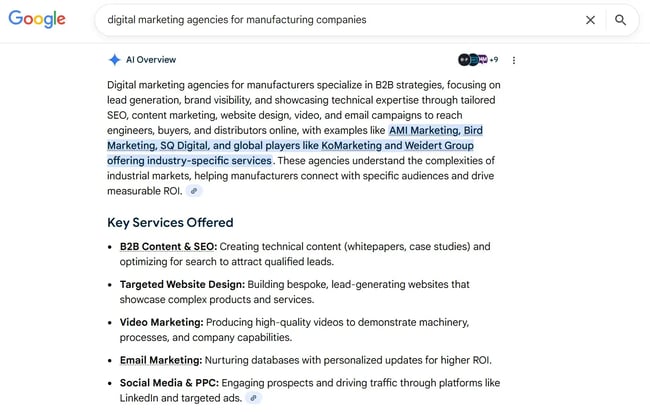
Here’s an example where a directory provides AI Overviews with the clarity it needs to recommend a marketing agency, even when the agency itself isn’t ranking in traditional SEO results.
Bird Marketing is a digital marketing agency specializing in manufacturing marketing. They created highly targeted, relevant landing pages on their website. Alongside that, trust is built through a third-party site, Semrush Agency Partners, tagging their expertise in manufacturing. This consistent message across domains helped Bird secure the feature in AI Overview.
GEO Trends You Can Act on Now
These AI trends focus on what teams can implement today to improve visibility, credibility, and performance in generative search.
Create brand guidelines for third-party alignment.
How others describe a brand matters as much as how a brand describes itself. Generative engines synthesize information from across the web, including media coverage, directories, reviews, partner sites, and social platforms, to form a consistent understanding of what a product or service is and when it should be recommended.
Every brand should already have brand guidelines for third-party alignment, but GEO highlights the importance of consistency.
How to get started:
- Document core positioning. Clearly define what the product or service does, who it’s for, and the primary problems it solves in plain, repeatable language.
- Standardize category and use-case language. Specify how the brand should be categorized (e.g., “B2B SEO platform” vs. “marketing software”) and which industries, audiences, or scenarios it serves best.
- Create an approved description set. Develop short and long descriptions that partners, directories, and PR teams can reuse to avoid variation and drift.
- Align owned content first. Ensure the company’s website, blog, and landing pages use the same terminology before extending guidelines externally.
- Share guidelines with partners and platforms. Provide consistent descriptions to directories, review sites, affiliates, and technology partners so third-party mentions reinforce the same narrative.
- Audit third-party mentions regularly. Review how the brand is described across the web and correct inconsistencies that could confuse AI systems.
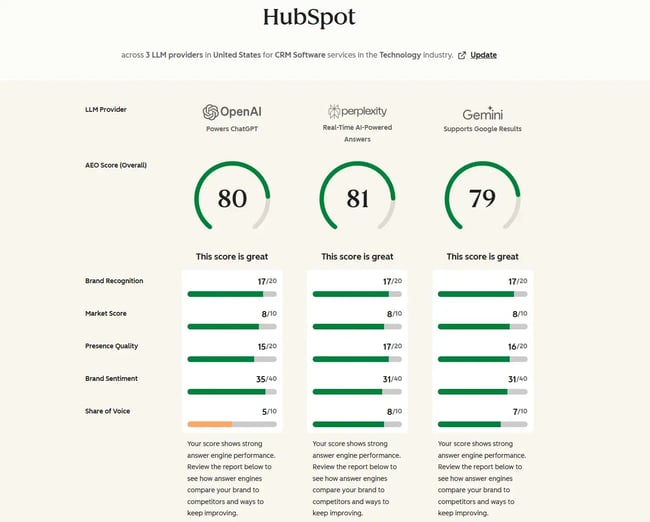
Pro tip: Brand consistency rarely results in sudden visibility spikes or dramatic movement. It works quietly in the background over time. One practical way to assess brands consistently is with HubSpot’s AEO Grader, which allows marketers to test how well their site supports both AEO and GEO, including brand signals, content structure, and AI accessibility.
Use it to monitor:
- AEO efforts overall
- Brand recognition
- Market score
- Presence quality
- Brand sentiment
- Share of voice
Format content and employ semantic triples.
Schema helps pages gain visibility in AI search tools like AI Overviews, and it’s reasonable to conclude this is due to the clarity and structure it provides.
When marketers and SEOs upload content to their website, they can easily add structured elements with some on-page considerations.
The table below features formatting options, what they are, and why they matter for GEO:
I don’t think any company needs to revisit its entire website and add structured elements like bullet points and tables, but SEO and marketing teams can start thinking about structure for future marketing content pieces.
In practice, many teams are using AI assistants like HubSpot Breeze AI to generate first drafts that already follow these structural patterns, making it easier to scale well-formatted, AI-readable content without sacrificing clarity or consistency.
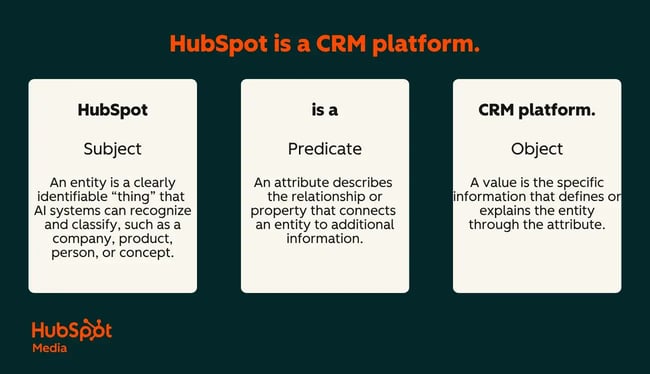
In addition to this, content marketers can become more definitive in the way they write. At HubSpot, one thing we do is use semantic triples, which follow a simple structure:
An example is: HubSpot is a CRM platform.
Using this format, the content clearly expresses the relationships for AI systems to interpret, summarize, and reuse in generated answers.
Need more support? Read:
Query Fan Out and Structured FAQs
Query fan out describes how a single user question expands into many related follow-up questions as people (and AI systems) seek clarity, validation, and next steps. One query rarely exists in isolation. For example, a search in an AI tool for “What is enterprise SEO?” quickly fans out into cost, tools, risks, timelines, comparisons, implementation, and who it’s for.
In some AI search tools, like Sigma Chat, users can see the follow-ups and query fan out:
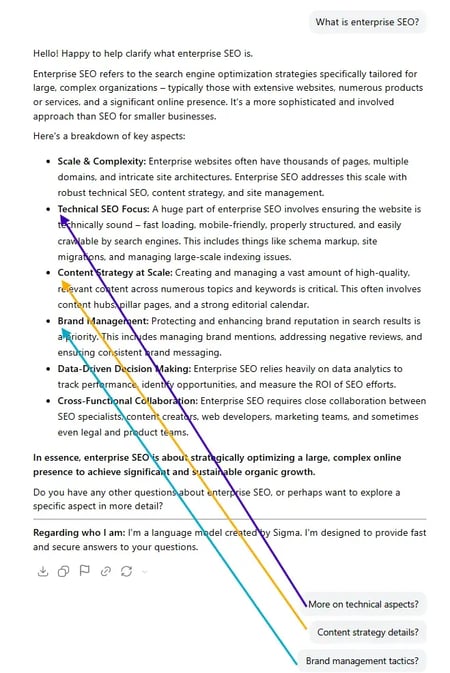
See how the recommended follow-up questions have already been researched and included in the original answer? This is because AI search tools don’t retrieve one answer; they try to map the full question around a topic to provide a comprehensive answer. Content that only answers a narrow slice may rank or be cited occasionally, but content that demonstrates broad, structured coverage is far more likely to be trusted, summarized, and reused in AI-generated responses.
This is where FAQs become strategic.
Marketers can use FAQ-style content to present their website and brand as a comprehensive knowledge base, worthy of citation.
There are two main ways to handle FAQs:
- Creating unique articles or pages to comprehensively cover the answer to a question.
- Adding FAQs to the bottom of the page, either in H3 and body text, or within accordions or FAQ modules.
FAQs deserve their own dedicated article when:
- The answer requires depth, nuance, or examples, not a paragraph or two.
- The query fan-out is large enough that answering everything in-line would overwhelm a core page.
- Marketers want the page to stand on its own as a reference that AI systems can cite.
Examples of FAQs that deserve a page:
- How to do X
- How does X differ from Y?
- Is X better than Y?
- What factors affect X?
An FAQ module within a page works best when:
- The questions are supportive, not primary (clarifying objections, edge cases, or logistics).
- Answers are concise and directly tied to the page’s main intent.
- The goal is to reduce friction or uncertainty rather than capture a new query set.
Examples of FAQs that support a page:
- “How quickly can we see results?”
- “Do you offer month-to-month contracts?”
Schema
Schema markup is structured data added to a site’s HTML that helps AI crawlers understand what the content is about, who it belongs to, and how different entities relate to one another. In a GEO context, schema isn’t about earning rich results — it’s about reducing ambiguity so generative engines can confidently extract, summarize, and cite the content. As stated in the study aforementioned, when implemented properly, schema increases a brand’s chances of future-proofing GEO visibility.
Important: Adding schema is technical, and I’ve written an in-depth article on GEO schema here. This article goes into the technical details, including examples of schema, and how to manage schema with a schema graph. It’s technical, but it’s very comprehensive and will get anyone started.
For this article, I’m going to provide some steps for getting started:
- Learn the basics before implementing anything. SEO professionals should familiarize themselves with common schema types like Organization, Person, Article, Product, and Service on schema.org.
- Audit what the company already has. Check whether the site is already using schema and identify gaps, inconsistencies, or orphaned entities using schema validation tools. If using plugins like Yoast for WordPress, or HubSpot’s Content Hub, schema might be automatically added, putting the site in a better place than expected.
- Align with the developer early. Schema works best when implemented at the template level, so collaborate with the company developer to agree on where and how structured data should be injected across page types.
- Use AI tools to generate a starting point. Tools like ChatGPT can help SEOs draft an initial JSON-LD schema for key entities. Treat this as a starting point because an AI-generated schema is often valid but not meaningful. Review and refine schema to ensure accuracy and alignment with the actual content.
- Start with high-impact pages. Implement schema on core pages first, such as the homepage, about page, key service or product pages, and top-performing content, before scaling sitewide.
- Validate and iterate. Test the schema using Google’s Rich Results Test and schema validators, then monitor how the brand appears in AI-generated answers over time.
Pro tip: HubSpot’s Content Hub is a CMS that surfaces SEO and GEO recommendations directly within the writing experience. As content marketers create content with the AI content writer, it flags relevant tactics to improve the chances of visibility not only in traditional search but also across AI-driven discovery and answer engines.
Frequently Asked Questions About the Future of Generative Engine Optimization
How is GEO different from SEO in day-to-day work?
GEO shifts daily focus away from ranking mechanics and toward whether the content can be understood, trusted, and reused by AI systems. Practically, this means more time spent on entity clarity, question coverage, internal consistency, source-worthiness, and content structure. There’s less onus on individual keywords or SERP positions.
When should you create an llm.txt or ai.txt file?
Developers should create an llm.txt or ai.txt file as soon as they’re ready. Some platforms, like WordPress and Yoast, make setting up llms.txt very easy, and it dynamically updates like a sitemap. At the moment, llms.txt and ai.txt files are extremely experimental. They’re proposed ideas for helping AI crawlers, not a universally accepted tactic.
How do you measure “reference rate” in practice?
Reference rate is measured by observing how often your brand, content, or concepts appear in AI-generated answers across platforms such as ChatGPT, Perplexity, and Google’s AI surfaces. In practice, this involves a mix of prompt testing, brand-mention tracking, citation monitoring, and comparing inclusion frequency across competitors for the same question sets, rather than relying on a single metric.
Tools like xfunnel can help operationalize this by tracking brand inclusion, citation trends, and competitive share across LLM-driven search environments. HubSpot’s free AEO Grader provides an overview of how a site is appearing in AI search and recommendations to improve.
Should SMBs invest in GEO now or wait?
Most SMBs shouldn’t treat GEO as a separate investment yet, but they shouldn’t ignore it either. The smartest move is to enhance traditional SEO strategies with the work that moves the needle for GEO. For example, use schema, structure content well, and get consistent across the web.
Do you need GEO services or a course to get started?
No — most teams can get started by strengthening SEO fundamentals they already control: content structure, topical coverage, technical accessibility, and clarity of positioning. GEO services or courses only become valuable once you’ve hit limits internally or need to systematize and scale what you’re already doing, not as a prerequisite for participation.
What Actually Matters Next for the Future of GEO
The future of GEO isn’t about chasing new hacks or abandoning SEO; it’s about doubling down on tactics that help pages rank in traditional SEO and in generative search experiences, including clear entities, comprehensive question coverage, structured answers, and technically accessible content across a website.
If it feels overwhelming, know that GEO is an SEO enhancement and platforms like HubSpot have years of experience in search engine optimization, which puts them in great stead to support brands as they embrace GEO.
Want a hand earning GEO visibility? Try HubSpot’s Content Hub. HubSpot’s Content Hub offers SEO and GEO suggestions where relevant. It also makes light work of schema implementation.