








You can have a solid marketing strategy on paper and still miss the mark in the real world for one simple reason: your audience isn’t one audience.
As your customer base grows, so do the differences in what people need, value, and pay attention to. A message that feels “pretty relevant” to everyone often ends up feeling deeply relevant to no one, which is how campaigns become easy to ignore, hard to remember, and expensive to scale.
This is exactly why segmenting your target market is crucial.
What is market segmentation?
Market segmentation is the process of dividing a target market into distinct groups based on shared characteristics such as demographics, behaviors, or needs. This allows businesses to tailor products, services, and marketing strategies to each segment for higher relevance and profitability.
And when you’re managing multiple segments at once, marketing automation software can help you deliver that personalization at scale, without turning every campaign into a manual, one-off effort.
In the next section, we’ll start with the “why”: what market segmentation actually improves (from retention to growth to more efficient spend) before breaking down the main types and how to build your own strategy.
TL;DR: Everything you need to know about market segmentation
- How does market segmentation work? It uses customer data to identify patterns, group similar buyers, and tailor messaging, offers, and experiences to each segment.
- What are the main types of market segmentation? The four core types are demographic, geographic, psychographic, and behavioral, with additional methods like firmographic and needs-based segmentation.
- What advantages does market segmentation offer? Segmentation improves relevance, increases retention, reduces wasted spend, and helps uncover new growth opportunities.
- What are the disadvantages of market segmentation? Segmentation can fail if data quality is poor, segments become outdated, or groups are too small to generate profitable scale.
- How do you successfully implement market segmentation? Define your market, build data-backed segments, test performance, and refine continuously as customer behavior changes.
Why is market segmentation important?
Now that you understand what market segmentation is, let’s talk about why it plays such a critical role in modern marketing strategies.
Segmentation isn’t just about organizing your audience; it’s about improving performance across every stage of the customer journey. When done well, it helps brands build relevance, reduce wasted spend, and create experiences customers actually want to return to.
Improved customer retention
Customers are far more likely to stay loyal to brands that understand them. When messaging, offers, and experiences align with a customer’s specific needs, it creates a smoother journey and a stronger emotional connection.
A single negative experience can be enough to push customers toward a competitor, and dissatisfied customers are often quick to share that experience with others. Segmentation helps reduce that risk by ensuring customers aren’t served irrelevant or frustrating interactions in the first place.
By tailoring communication to each segment, brands can proactively deliver positive experiences that strengthen trust and long-term retention.
Sustainable business growth
Market segmentation also helps uncover new growth opportunities.
When you analyze your audience at a deeper level, patterns begin to emerge: unmet needs, under-served segments, or use cases your product already supports but hasn’t been marketed toward effectively. These insights can lead to new campaigns, new product offerings, or even entirely new markets.
Instead of guessing where to grow next, segmentation gives you a data-backed path forward.
More efficient marketing spend
Broad, one-size-fits-all campaigns are expensive and inefficient. Segmentation allows you to focus your budget and effort where they’ll have the greatest impact.
When you know who you’re speaking to and what matters to them, your campaigns become more precise. Messaging lands faster, conversion rates improve, and less money is wasted on audiences that were never a good fit to begin with.
In short, relevance reduces waste, and segmentation is what makes relevance possible.
What are the four types of market segmentation?
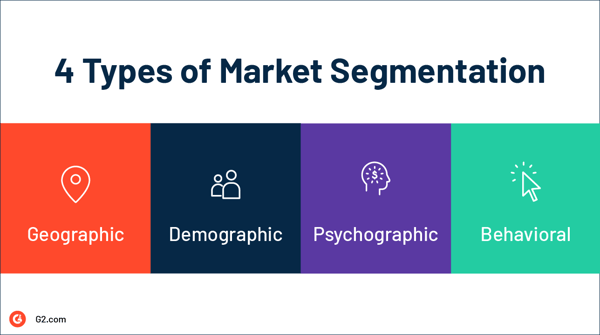
There are several ways to segment a market, and most brands don’t rely on just one. The four types below form the foundation of most segmentation strategies and are often combined for better precision.
Geographic segmentation
Geographic segmentation targets customers based on a predefined geographic border. Differences in interests, values, and preferences vary dramatically across cities, states, and countries, so it’s important for marketers to recognize these differences and tailor their advertising accordingly.
Example of geographic segmentation:
Think about products such as parkas and bathing suits.
Parkas will be sold most of the year in the colder northern half of the country, whereas southern areas may only be able to find parkas in specialty stores during the wintertime. On the other hand, bathing suits are sold year-round in warmer states but are typically only sold during spring and summer in cooler states.
Another example of geographic segmentation is the iconic fast-food chain McDonald’s. If you’ve never traveled to another country and set foot in a McDonald’s, you’re in for a surprise!
In Japan, McDonald’s offers the Teriyaki Burger, while in India, it features the McSpicy Paneer. It has many other localized menu items, reflecting its strategy of segmenting customers by location to better suit diverse food preferences worldwide.
Demographic segmentation
Demographic segmentation divides a market through variables such as age, gender, education level, family size, occupation, ethnicity, income, and more. This form of segmentation is widely used due to specific products catering to obvious individual needs relating to at least one demographic element.
Age is arguably the most apparent variable, and it is essential for marketers to comprehend, given how quickly preferences shift across different life stages.
Even media consumption differs greatly across generations, so it’s important to recognize your target age range and which channels they use to consume information to ensure your tailored message reaches them effectively.
Example of demographic segmentation
Clothing companies cater to multiple age groups. For instance, Lululemon sells athletic clothing to adult men and women of all ages, but they also cater to girls between the ages of 6 and 15.
By analyzing its current customer base, Lululemon saw an opportunity to serve a new market and expand its business.
Many clothing companies cater to a variety of age groups to reach as many customers as possible. Think H&M, Old Navy, and Zara. All of these companies cater to men, women, and children of all ages, and they have distinct labels, advertising, and styles for each segment.
Psychographic segmentation
Unlike geographic segmentation and demographic segmentation, psychographic segmentation focuses on the intrinsic traits your target customer possesses.
Psychographic traits can range from values, personalities, interests, attitudes, conscious and subconscious motivators, lifestyles, opinions, and more.
To understand your target audience on this level, methods such as focus groups, surveys, interviews, audience testing, and case studies can all prove to be successful in compiling this type of conclusion.
Think about the lifestyle of someone who lives in a small beach town and surfs for a living versus someone who lives in a big city working in corporate America. These two people have very different wants and needs on a daily basis, and marketers must recognize those differences to succeed.
Example of psychographic segmentation
For example, Starbucks does a fantastic job segmenting its customers based on psychographic traits. We all know that not everyone loves coffee or prefers to drink it, but that doesn’t stop Starbucks from appealing to just about everyone.
Starbucks sells chocolate milk, cake pops, granola bars, cheese sticks, and more for the little kids who accompany mom or dad on their morning coffee run. Of course, those items aren’t strictly for the kids, but those items sure are tempting when you have a little one.
What about those sophisticated coffee drinkers who care about quality and bean sources? Starbucks appeals to them by offering a variety of exotic beans sourced from regions around the world. And what about those who don’t really drink coffee, but all of their friends do, and they enjoy an afternoon hangout at Starbucks? Think frappuccinos, lemonades, teas, and juices.
Selling products that appeal broadly is one challenge, but making each person feel personally valued is another. Starbucks achieves this by crafting messages that foster a sense of belonging.
They cater to each segment’s wants and needs through targeted marketing campaigns to ensure their coffee brand is inclusive to all, even if you aren’t a coffee drinker.
John Donnachie
Director, ClydeBank Media
Behavioral segmentation
Behavioral segmentation has similar measurements to psychographic segmentation, but instead, it focuses on specific reactions and the ways customers go through their decision-making and buying processes.
Attitudes towards your brand, the way they use and interact with it, and their knowledge base are all examples of behavioral segmentation. Collecting this type of data is similar to the way you would find psychographic data.
Brand loyalty is an excellent example of behavioral segmentation. While reading this article, I bet that you can think of one brand that you consistently purchase and trust enough to buy its newly launched product without even reading the reviews.
This type of brand loyalty produces a consistent buying pattern, which is categorized as a behavioral trait. Marketers work hard to get customers to love and stay loyal to their brand for a consistent purchase cycle.
To target customers with strong brand loyalty, many companies offer rewards programs to reinforce this behavior and attract new loyal customers.
Example of behavioral segmentation
For example, the makeup and beauty company Sephora has an excellent rewards program for its loyal customers. The more you spend at their store, the more points you rack up, which can be redeemed for generous samples. In addition to that, they offer free services, special access to sales, and more!
By targeting and rewarding those who already had an affinity to their brand, Sephora was able to build an impressive community that their target market wants to be a part of.
What are the steps in the market segmentation process?
Once you understand the types of market segmentation, the next step is putting them into practice. While the process may look different depending on your business, most successful strategies follow a similar core workflow.
- Define your target market: Start by clearly identifying the market you operate in. Ask foundational questions: Who is this product or service for? What problem does it solve? How large is the opportunity? Who are your competitors? This step sets the boundaries for everything that follows. Without a clear market definition, segmentation efforts can become scattered or unfocused.
- Choose your segmentation approach: Next, decide which segmentation method or combination of methods best fits your goals. Many brands blend demographic, psychographic, behavioral, and geographic data to build more accurate segments. There’s no requirement to limit yourself to a single approach. The key is choosing criteria that meaningfully influence how customers discover, evaluate, and purchase your offering.
- Research and understand your audience: With your segmentation criteria selected, gather data to understand each group. This can include surveys, interviews, focus groups, customer feedback, product usage data, and campaign performance metrics. At this stage, it’s important to ask questions that lead to measurable insights, not just opinions. The stronger your data, the more actionable your segments will be.
- Build and validate customer segments: Analyze your findings to create distinct, reachable customer segments. Each segment should be large enough to be profitable and clearly differentiated from the others. Avoid over-segmentation. If a group is too small or lacks buying power, it may not justify a dedicated strategy. Validation through early testing can help confirm whether your segments are practical.
- Launch, test, and refine your strategy: Once your segments are defined, put them to work. Launch targeted campaigns, track performance, and test different messages or offers through A/B testing. Segmentation is not a one-time exercise. As customer behavior changes and markets evolve, revisit your data regularly and refine your segments to stay aligned with real-world demand.
| Aspect | Concentrated strategy | Differentiated strategy |
| Market focus | One clearly defined segment | Multiple distinct segments |
| Messaging | Single, highly targeted message | Tailored messaging by segment |
| Resources needed | Lower budget and effort | Higher budget and complexity |
| Risk profile | Higher risk if the segment fails | Lower risk due to diversification |
| Growth potential | Limited by niche size | Greater, more scalable growth |
| Best for | Startups or niche-focused brands | Established or scaling brands |
Most companies start with a concentrated strategy to gain traction, then evolve into a differentiated approach as their product, data, and resources mature.
What are the most common market segmentation mistakes?
Even well-intentioned segmentation strategies can fall short if a few common pitfalls aren’t addressed early. Below are the mistakes marketers make most often and how to avoid them.
Creating segments that are too small
It’s easy to over-segment when you’re trying to be precise. While detail is important, segments that are too narrow often lack enough buying power to justify the time, budget, and resources required to target them effectively.
At the end of the day, no two customers are identical. Trying to account for every variable can result in segments that look good on paper but don’t scale in practice.
How to avoid it: Make sure each segment is measurable, reachable, and profitable. If a segment can’t support a distinct campaign or generate meaningful ROI, it’s likely too small.
Failing to update your segmentation strategy
Customer preferences, behaviors, and expectations change; sometimes quickly. Segments that were accurate a year ago may no longer reflect how your audience thinks or buys today.
When segmentation is treated as a one-time project instead of an ongoing process, it becomes outdated and less effective over time.
How to avoid it: Review and refresh your segmentation regularly. Whether that’s quarterly, annually, or triggered by noticeable changes in customer behavior, build reassessment into your strategy so it evolves with your audience.
Targeting interest instead of buying power
A segment might align perfectly with your brand values or messaging goals, but if it lacks a genuine need for your product or the budget to purchase it, the strategy won’t produce results.
Large or enthusiastic segments don’t always translate into revenue.
How to avoid it: Balance relevance with viability. Prioritize segments that combine genuine need, willingness to buy, and long-term value, not just engagement or surface-level interest.
Relying on assumptions instead of data
Segmentation built on assumptions, stereotypes, or outdated insights can quickly miss the mark. Without reliable data, even well-crafted messaging can feel irrelevant or disconnected.
How to avoid it: Use a mix of qualitative and quantitative data: surveys, interviews, behavioral analytics, and performance metrics to validate your segments before fully committing to them.
Best marketing automation software for 2026
G2 helps businesses find the best marketing automation software for streamlining campaign execution, personalizing customer journeys, and scaling demand generation efficiently.
Below are the five best marketing automation software platforms, based on G2’s Winter 2026 Grid® Report.
Frequently asked questions about market segmentation
Got more questions? We have the answers.
Q1. What are some other types of market segments?
Beyond the four core types (demographic, geographic, psychographic, and behavioral), businesses often use firmographic segmentation (company size, industry, revenue), technographic segmentation (tools and technologies used), needs-based segmentation, and value-based segmentation. These approaches are especially common in B2B and SaaS environments where buying decisions depend on organizational context, not just individual traits.
Q2. How does market segmentation work?
Market segmentation works by collecting customer data, identifying meaningful patterns, and grouping customers based on shared characteristics that influence buying behavior. These segments are then used to tailor messaging, offers, products, and experiences, which improves relevance and performance across marketing, sales, and customer success efforts.
Q3. What are the benefits of market segmentation?
Market segmentation helps businesses deliver more relevant experiences, improve customer retention, uncover new growth opportunities, and reduce wasted marketing spend. By focusing efforts on high-value segments, teams can prioritize resources more effectively and drive stronger ROI.
Q4. What are the limitations of market segmentation?
Market segmentation requires accurate data, ongoing maintenance, and cross-team alignment. If segments are built on assumptions, become outdated, or are too small to scale, they can limit growth rather than enable it.
Q5. How is market segmentation different from targeting and positioning?
Segmentation identifies groups within a market, targeting selects which segments to focus on, and positioning defines how a brand or product is perceived by those segments. These three steps work together, but segmentation comes first.
Q6. Is market segmentation more important in B2B or B2C?
Market segmentation is critical in both, but it looks different. B2C segmentation often focuses on demographics and behavior, while B2B segmentation relies more heavily on firmographics, buying roles, and organizational needs.
Q7. What data is most useful for market segmentation?
The most useful data combines behavioral data (purchase history, usage patterns) with demographic or firmographic data and qualitative insights from surveys or interviews. Using multiple data sources helps create segments that are both accurate and actionable.
Take your marketing strategy to the next level
Market segmentation isn’t about putting people into boxes; it’s about understanding what actually drives decisions and using that insight to create relevance at scale. When brands take the time to segment their audience thoughtfully, they move beyond generic messaging and start delivering experiences that feel intentional, timely, and valuable.
The most effective segmentation strategies are built on real data, tested continuously, and refined as customer behavior evolves. Whether you focus on a single niche or serve multiple segments, the goal remains the same: meet customers where they are with messaging and experiences that match their needs.
To take your segmentation strategy even further, explore how an omnichannel marketing strategy helps you deliver consistent, personalized experiences across every touchpoint.
This article was originally published in 2021. The content has been updated with new information.