





The following is a special guest post by Jon Miller, a legend in our industry, the co-founder and original CMO of Marketo, and a leading architect of modern B2B marketing and ABM as we know it. Now the co-founder and CEO of a new stealth AI startup in this space, this is what he anticipates we’ll see in the year ahead.
This is my fourth year writing predictions for B2B go-to-market. You can read the 2023, 2024, and 2025 editions, and I publicly grade myself each year. (Here are my grades for 2025.) I don’t always get it right, but forcing myself to commit to specific predictions — and then facing the scorecard — helps me think about what’s actually changing (versus what’s just noise), and how to navigate the year.
2026 feels like a year where the vision of AI-powered marketing comes into focus: agents joining buying committees, reasoning systems replacing brittle rules, orchestration that finally delivers on the decades-old promise of 1:1 personalization. But actual enterprise adoption will remain incremental and the gap between where we’re going and what actually happens in 2026 will be large.
Here are the predictions:
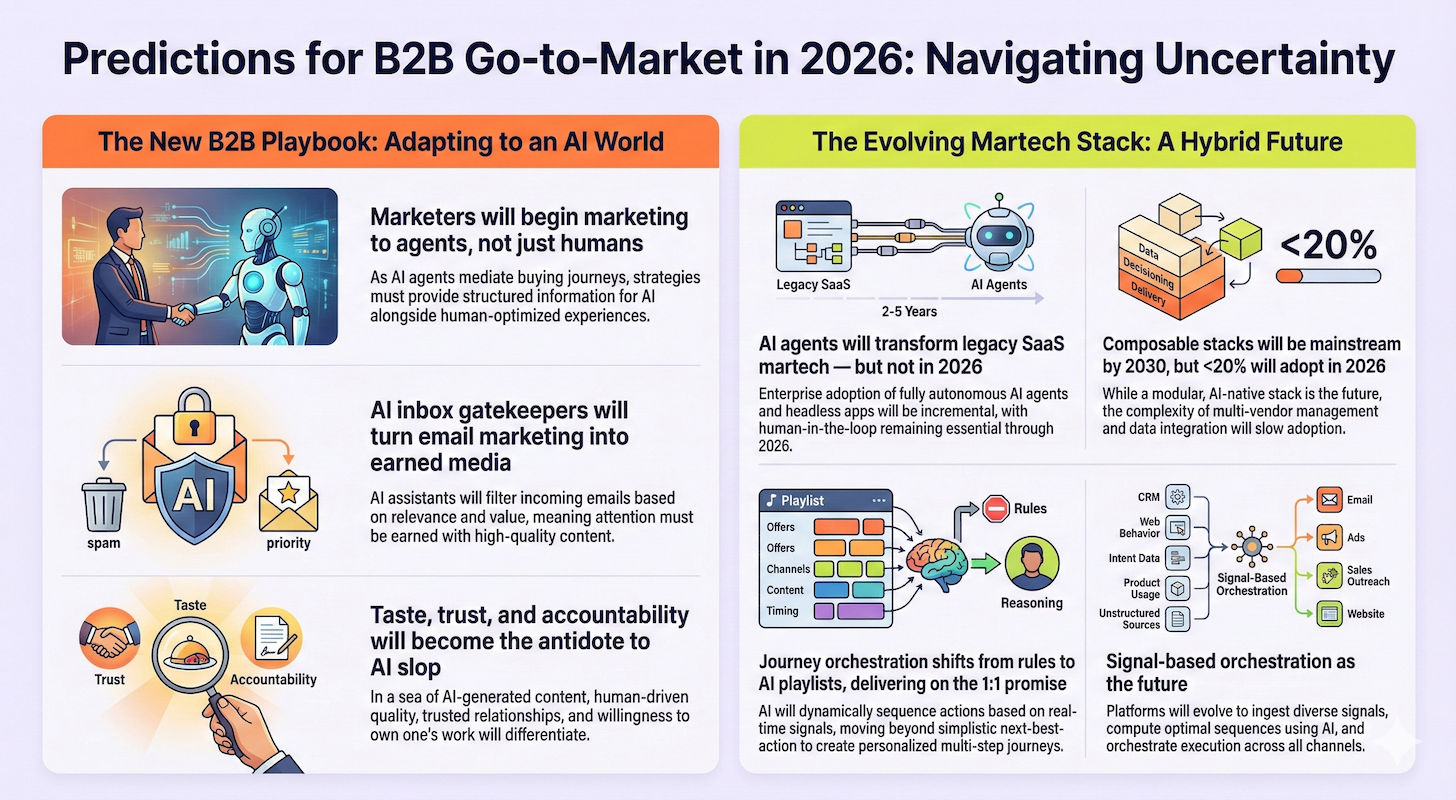
- Marketers will begin marketing to agents, not just humans
- AI will completely transform legacy SaaS martech — but not in 2026
- Composable stacks will be mainstream by 2030, but <20% will adopt in 2026
- Context engineering will emerge as a recognized practice across GTM teams
- Reasoning AI will begin replacing rules-based automation
- Journey orchestration shifts from rules to AI playlists, delivering on the 1:1 promise
- AI inbox gatekeepers will turn email marketing into earned media
- Taste, trust, and accountability will become the antidote to AI slop
- Public intent signals will commoditize; proprietary signals generate “alpha”
- Where martech is heading beyond 2026
- Rapid-fire mini-predictions
- AI-driven uncertainty will intensify in 2026; preparation is the only answer
Marketers will begin marketing to agents, not just humans
Prediction: In 2026, marketers will market to agents, not just humans. As buying journeys become increasingly AI-mediated — with agents researching and evaluating vendors alongside human stakeholders — marketers will deliver the structured information AI needs, while also investing in the human experiences and relationships that close complex deals. Scott Brinker calls this ‘from martech to marketing to tech’, treating AI agents as part of the buying committee.
What’s already happened:
2025 was the year of Answer Engine Optimization (AEO). 90% of B2B buyers used tools like ChatGPT for research, and 72% encountered Google AI Overviews during vendor evaluation (TrustRadius 2025 report). That’s why 63% of marketers are publishing AI-optimized content like structured FAQs and schema markup (Martech for 2026 report from Chiefmartec and MartechTribe), as well as optimizing their presence on platforms where LLMs source answers like Reddit and G2. And the Digital Bloom reports 51% of companies plan to increase AEO investment, versus 14% for traditional SEO.
What will change:
AI becomes the new analyst briefing: How AI describes your company will be a key product marketing KPI. Executive teams will obsess over how AI positions them versus competitors, the same way they obsessed over Google rankings.
AI advertising: We will see early adoption of paid ads in AI results. Perplexity already has sponsored follow-up questions and Google shows search and shopping ads in AI-generated summaries, especially for complex or commercial queries. OpenAI has plans to monetize free users with ads, though those are temporarily deprioritized following December’s “code red” to focus on core product quality. I’m especially excited to see audience targeting come to paid AEO, though I suspect this is post-2026. The ability to bid more for known contacts and accounts — similar to how paid search can target specific audiences today — will let marketers focus on the buyers and accounts that matter most.
Agent identification and tracking: When an AI agent requests pricing information or product specs from your site, that’s first-party intent, and teams should incorporate those signals into scoring and buying stage predictions. Put simply, agent visitors will contribute to Marketing Qualified Accounts (MQAs) just like human visitors. This will require “agent deanonymization”: an unknown startup’s agent researching your category may be noise, while a Fortune 500 company’s agent comparing your capabilities against competitors could be pipeline.
Content architecture for dual audiences: Marketing to both humans and agents will require rethinking content architecture. This will lead to a “headless” model: a foundation layer of core data, content, and services that serves two distribution paths. Humans get branded website experiences optimized for emotional engagement. Agents get direct access to services — think pricing APIs that deliver dynamic quotes, or knowledge bases that can answer detailed product questions. Both get responses personalized to their role and buying stage. Building this capability requires robust infrastructure that can field detailed queries accurately; chat vendors like Qualified have been building these systems, which likely contributed to their acquisition by Salesforce.
Agent nurturing: This one is pure speculation, but it may be computationally expensive for an agent to regularly ping a company for relevant updates. Agents might instead ‘register’ or ‘opt-in’ to receive proactive updates from companies their humans care about. If that happens, ‘agent nurturing’ could emerge as a channel.
What won’t change:
AI agents optimize for objective criteria: capabilities, pricing, compliance requirements. They don’t care about your brand story.
But humans still make final decisions, at least for now. The 6sense Buyer Experience Report for 2025 showed human buyers averaged 16 vendor interactions, unchanged from 2024. Complex purchases require human validation, relationship building, and trust. Agents compress research time, but people sign contracts.
Hot take: AEO tactics will prove temporary
The work to optimize static content for AI engines (special markup, structured FAQs, machine-readable formatting) feels like early SEO, when people stuffed keywords and gamed algorithms. Google has long said don’t create content for machines, create for humans. Even their current AI documentation confirms: “You don’t need to create new machine-readable files, AI text files, or markup to appear in these features.”
The headless service infrastructure I described above may prove durable, but the static content markup tactics will likely become unnecessary as AI gets better at reading human-optimized content. Over time, I predict we won’t need to optimize our content for AI, which is exactly what happened in search.
AI will completely transform legacy SaaS martech — but not in 2026
If you spend any time on LinkedIn, you’ve seen the proclamation: “SaaS is dead.” As Scott Brinker says, if you only follow the techno-optimist influencers claiming to run entire departments with vibe-coded agents, you might feel desperately behind.
Here’s what that vision looks like: you describe your goal and AI orchestrates everything across channels, no campaign builder required. “Promote our Q4 launch to enterprise accounts in financial services” becomes a single request that an AI translates into personalized content, coordinated timing, channel selection, and budget optimization.
Prediction: Yes, AI will reshape marketing technology — but it will take the next 2-5 years. 2026 will be a year of hybrid experimentation, not wholesale transformation, in which SaaS platforms (old and new) will coexist with agentic AI, and human-in-the-loop will remain essential across nearly all implementations.
The three disruption fronts:
AI is driving three disruptive shifts in legacy SaaS:
1. From software tools to autonomous agents: When you can hire digital workers who never sleep, never quit, and scale infinitely, why pay for software licenses? Many of the fastest-growing AI companies (Cursor, Harvey, etc.) aren’t about helping humans work better, they’re about replacing labor entirely.
Brendan Short argues the next major GTM company will be one that “sells labor” rather than software, likely in the form of AI agents managed by GTM operators. You’ll no longer buy software that helps people do work; you’ll hire AI to do the work. You’re paying for outcomes, not seats.
2. From user interfaces to headless applications: Instead of logging into individual platforms, many humans will work in their chatbot of choice. For these users, the functionality exists, but the user interface layer disappears. A great use case for this is analytics; a CMO simply asks their AI chatbot “which campaigns performed best this quarter”? (That said, I’ll note that chat isn’t always better than clicks. For experienced users doing repetitive tasks, a familiar UI often beats describing what they want and waiting for an agent to interpret it.)
This is why the Model Context Protocol (MCP) is so exciting. And MCP solves the integration mess: instead of building custom connectors between every AI application and every tool, it provides a standardized protocol where each builds one connection and everything works together.
3. From monolithic platforms to composable apps: AI can now code mini-applications to solve specific problems, often without being asked. And users can “vibe code” simple solutions themselves. Over time, this will reduce the number of lower-value “apps” in various app stores.
But there are limits to how far this can go. “Martech for 2026” shared a good framework: simple apps (basic dashboards, internal tracking tools) work fine for non-engineers. But anything handling sensitive data needs qualified developers, and complex enterprise platforms (CRM, MAP) should still be bought from commercial vendors. The likely outcome: core platforms from trusted vendors, surrounded by bespoke mini-apps filling company-specific needs.
Why not 2026:
These disruptions will transform martech, but more slowly than the hype suggests. In 2025, 81% of AI usage is ‘assist-only’ while less than 10% let agents act autonomously. Why so slow?
- Enterprises move slowly. Brinker’s Martec’s Law states that technology changes faster than organizations can absorb it. Think how long past tech transitions (mainframe to enterprise software, enterprise software to SaaS) took. Within marketing, consider how long MQLs have persisted despite better options like MQAs. The shift is happening, but it’s measured in years, not quarters.
- Enterprise requirements. SaaS platforms are more than their user interfaces. They’re valued for the infrastructure that takes years to build right: compliance and security, governance and auditability, scalability and integrations. AI doesn’t eliminate the need for these capabilities.
- Technical complexity. Dynamic agent orchestration for millions of contacts with complex real-time decisioning requires serious infrastructure. Bidirectional sync with Salesforce, complex data models, edge case handling — these hard engineering problems don’t disappear because you added an AI layer.
- AI hallucinations persist. The risk of confident but incorrect outputs remains a significant barrier to autonomous operation, particularly for mission-critical activities. You can’t have agents dynamically deciding whether to honor CAN-SPAM opt-outs or GDPR deletion requests. So human-in-the-loop will be around for a while.
- The pricing model tells the real story. If SaaS were truly dead, we’d see widespread outcome-based pricing. Instead, Salesforce recently introduced its Agentic Enterprise License Agreement, which uses credits but is based on seats at the core. As CFO Amy Weaver explained, customers want seat-based pricing because ‘it gives you predictability.’ That tells you where enterprise confidence actually is.
What 2026 will actually look like:
Given these challenges, 2026 won’t look like autonomous agents running headless applications. It will look like SaaS with AI built in. Think of it like self-driving cars: we’re not getting full autonomy in 2026. We’re getting advanced driver assistance where the human stays alert and in control, ready to take over.
In 2026, enterprise marketers want a better Marketo, not a wholesale re-architecture. They want AI-assisted campaign creation that still shows them the workflow before it executes. They want intelligent audience segmentation they can review and adjust. They want AI providing “air traffic control” between campaigns to prevent message conflicts, but with traditional interfaces and human approval loops. That’s what will actually get adopted.
This also explains why we’ll likely see more traction from new AI-native platforms than from AI add-ons trying to retrofit legacy systems. The new platforms will be architected to be agentic, API-driven, and MCP-enabled at their core, while still supporting today’s UI-based workflows and human oversight patterns. Think of them as building the bridge: functional today with traditional interfaces, but ready to support fully agentic operation as enterprises become comfortable with that shift.
Composable stacks will be mainstream by 2030, but <20% will adopt in 2026
A composable martech stack is built from modular layers rather than a single vendor suite:
- A Data layer serves as the source of truth, combining customer data from multiple sources into actionable inputs
- A Decisioning layer handles intelligence like audience selection and journey orchestration
- Various Delivery tools execute messages across channels via APIs
The idea is that you choose the best tool for each job, swap components when better options emerge, and avoid vendor lock-in.
B2B marketers are moving in this direction, though slowly. According to The Digital Bloom’s analysis of martech stacks, marketing automation platforms’ role as the “center” of B2B stacks declined from ~31% to ~26% of respondents year-over-year, while custom platforms (a proxy for composable) grew from 2% to 10%. Today, most mid-market B2B firms still favor integrated platforms (like Marketo or HubSpot) over assembling a complex stack, but the trend is clear.
Prediction: By 2030, a modular, AI-native, signal-driven stack will be the norm in B2B marketing. But fewer than 20% of B2B teams will run a fully composable architecture in 2026.
Why so slow?
Flexibility shifts complexity; it doesn’t remove it. A composable stack trades vendor-managed convenience for flexibility and control. You gain customization, but you assume responsibility for making it all work together. MCP will slowly make this better.
Multi-vendor management is harder than it looks. Coordinating updates, support, contracts, and roadmaps across multiple vendors requires significant operational maturity. As Mike Lowndes, VP Analyst at Gartner, noted: “Especially in B2B, the challenges of adopting composable solutions are significant. Many organizations struggle to manage multiple vendors and contracts effectively, particularly if they lack the necessary digital maturity.”
Data warehouses aren’t built for marketers (yet). The idea of a central warehouse fueling all marketing sounds great, but in my experience these platforms are typically built for engineers and analysts, not everyday marketing users. Legacy martech platforms struggle to access the product or behavioral data stored there, leading to data silos, API limit workarounds, and engineers manually extracting data for marketing.
Decisioning and Delivery are hard to separate. In theory, an AI model in a standalone tool decides the next-best action and then triggers execution via API. In practice, it’s harder than it sounds. Your ESP might not support the dynamic personalization your model envisioned. More importantly, truly optimizing outcomes requires a closed feedback loop: capturing response data, converting it to learning, and feeding it back. As Real Story Group observed, “true orchestration requires closing the loop across data, decisioning, and content layers” — something few stacks achieve today.
The likely path: composable lite
Most B2B companies won’t leap to fully headless architecture overnight. Instead, they’ll adopt what I’d call “composable lite”: data-first and decision-first, but not fully decoupled.
In this model, the data warehouse becomes an important source of truth, but your MAP, website, chat tools, ad platforms, etc. aren’t just dumb execution channels. Final journey orchestration will live inside the MAP, even as scoring, segmentation, and some intelligence shifts toward the warehouse. It’s a stepping stone that lets teams capture real benefits without dismantling everything at once.
Context engineering will emerge as a recognized practice across GTM teams
Poor data quality is consistently cited as the biggest obstacle teams face with AI systems. But “data quality” undersells the problem. The real gap is giving AI the operational context it needs to act like someone who actually understands your business.
Prediction: In 2026, “context engineering” — the discipline of systematically capturing and structuring the knowledge that makes AI useful rather than generic — will emerge as a recognized practice across GTM operations teams.
What counts as context? It starts with connecting AI to the same data and knowledge sources your team relies on: CRM, data warehouse, call recordings, marketing platforms, internal documentation. But connection alone isn’t enough. AI also needs an enablement layer that explains what the data means and why. That means naming conventions for campaigns. The rules for which segments to include or exclude, and the reasoning behind those rules. What a ‘webinar campaign’ means at your company: which tactics to create, what the follow-up sequence looks like, how leads get routed. The reasoning behind your Salesforce schema after ten years of accumulated customization.
This operational knowledge isn’t formally captured anywhere. It lives in Slack threads, in tribal knowledge, in the heads of senior team members. When your best MOPs person leaves, it walks out the door with them.
Legacy marketing platforms don’t help. They can tell you what campaign a lead is in. They can’t tell an AI agent why that campaign exists, what the underlying strategy was, or which approaches your team tried and abandoned. Legacy systems store outcomes; they don’t capture decision logic.
What changes:
- Ops teams will spend time teaching their AI platforms ‘skills’: how to interpret the data schema; how to build a webinar campaign; which segments to use, and when. This looks a lot like onboarding a new hire, except the knowledge becomes durable and reusable rather than trapped in someone’s head. It also helps Ops evolve from a tactical ticket desk, becoming the team strategically responsible for making AI actually useful.
- AI systems will start capturing decision outcomes (what worked, what didn’t, why) so the next decision builds on the last. That’s the difference between AI that repeats mistakes and AI that learns how your business operates.
- As teams deploy multiple AI agents, the shared operational context becomes the coordination layer. Without it, agents work at cross-purposes; with it, they act like a coherent team.
- Martech vendors will begin to compete on how well they capture and expose operational context, not just on integrations or features.
Reasoning AI will begin replacing rules-based automation
Legacy marketing technology is built on rules engines. If job title contains “VP,” add 10 points. If email opened, wait two days, then send follow-up. If industry equals “Financial Services,” route to segment B.
Those rules are brittle. They can’t learn from outcomes, they break when market conditions shift, and they require expert-level knowledge and constant maintenance. Worse, they can’t handle the ambiguity that defines the real world.
Reasoning models can. They reason through problems, understand context, and test hypotheses. They recognize patterns without explicit rules, infer relationships from available data, and weigh multiple signals simultaneously.
Prediction: In 2026, reasoning AI will begin replacing rules-based logic across marketing and revenue operations, starting with data management, lead scoring, and journey orchestration (see next prediction).
The “Martech for 2026” report (Brinker, Riemersma) offers a useful spectrum for automation, from deterministic (repeatable and explainable, but rigid) to agentic (adaptive and resilient, but less predictable). Most legacy marketing tech sits on the deterministic end. The opportunity in 2026 is to move selectively toward the middle, incorporating reasoning AI for automations that benefit from contextual judgment while keeping deterministic logic where consistency matters.
This shift addresses what Justin Norris calls the “messy middle”: work that’s too variable for rigid rules but not strategic enough to justify senior attention. The Slack pings, data cleanups, exception handling, and small fixes that bury ops teams.
Marketing ops won’t disappear. Instead of configuring complex rule systems, teams will provide context: business goals, success metrics, guardrails, and data pipelines that give AI access to the signals it needs.
Journey orchestration shifts from rules to AI playlists, delivering on the 1:1 promise
The promise of 1:1 personalization has been around for decades, yet it remains mostly unfulfilled in B2B. After years of inflated vendor claims, any pitch about “personalized journeys” is met with justified skepticism.
Why has it been so hard? B2B buying involves non-linear journeys and large buying committees. Rules-based personalization devolves into spaghetti diagrams that are theoretically possible but practically unmanageable. And “next-best-action” is too simplistic for long B2B journeys; we need to think multiple moves ahead, not just one.
Prediction: In 2026, early adopters will implement AI-powered journey orchestration that dynamically sequences actions based on real-time signals. This helps AI drive more effectiveness, not just efficiency.
Why now?
This is a specific case of the shift from rules to reasoning described in the previous prediction. Rather than mapping every possibility into a complex workflow diagram, AI can finally think through all the possibilities to pick the best path for each buyer and account.
But journey orchestration also benefits from a second breakthrough: modern AI’s ability to work with the kind of data B2B actually has.
Traditional machine learning tended to flatten the behavioral signals that matter most, like which specific web pages and campaigns a buyer engaged with. Transformers and large language models work differently. They can encode everything known about a buyer and their account — engagement history, content preferences, timing patterns — into rich representations that capture behavioral nuances, making them perfect for B2B.
Right action beats content personalization
Most conversations about personalization focus on content: AI-generated emails mentioning someone’s LinkedIn post, dynamic copy blocks, personalized subject lines.
I think that’s the wrong focus. To me, 1:1 personalization means figuring out the right action for every buyer and account. An action combines four elements: offer, channel, content, and timing. You don’t need unique content for every buyer. You need the right action at the right time.
Instagram and TikTok prove this at scale. They don’t create unique content for each user; they intelligently sequence existing content into feeds that feel deeply personal.
Playlists, not shuffle
Most personalization engines pick the single best next action. That’s like putting music on shuffle: each song might be fine, but you lose the artistry of a well-sequenced album. In B2B, nobody buys because of one touch. And just as a language model writes better by looking several tokens ahead, AI can create better journeys by looking several actions ahead.
I call this approach “Playlists”: a sequence of upcoming actions, dynamically adjusted based on engagement signals and buyer context. You set the strategy and goals (the genre or mood), and AI curates a personalized sequence to move each buyer forward.
Playlists support:
- Dynamic sequencing: The playlist adjusts in real time based on engagement signals, timing, and context rather than following a fixed path.
- Mix and match at scale: Combining offers, channels, content, and timing from pre-approved libraries creates billions of unique action sequences without requiring millions of custom assets.
- Reinforcement learning: Instagram doesn’t know you like cat videos until it shows you one. You don’t know an executive prefers Sunday emails until you try sending on Sunday. The system explores, learns, and adapts.
Changing roles
In this model, the human’s job is to create compelling offers, experiences, and content: understanding markets, developing messages that resonate, crafting experiences that connect. The human also sets the boundaries: rules about who must or must not receive certain communications, budget limits, frequency caps, brand guardrails. They are defining the playlist’s constraints, not programming every song.
The AI figures out who gets what and when, across dozens of campaigns and thousands of accounts. It also handles air traffic control, ensuring buyers aren’t overwhelmed with conflicting messages. Humans shouldn’t be building Visio diagrams with endless if-then logic; we’re terrible at that complexity. Let AI handle the combinatorial math.
Meanwhile, humans will still monitor AI recommendations and make final decisions for a while. And transparency will always be non-negotiable. Why did this person get this campaign? Why didn’t someone qualify? What alternatives were considered? Without answers, teams can’t learn, debug, or trust the system.
AI inbox gatekeepers will turn email marketing into earned media
For years, marketers have treated email as ‘owned media’: you build a list, you control when to send, you own the access.
But that model is breaking down. As marketers and SDRs use AI to generate more messages faster (over 376 billion emails were sent daily in 2025, roughly half of them unwelcome), buyers are fighting back. Google’s Automatic Extraction may override preview text with AI-generated summaries of deals and offers; Yahoo Mail replaces subject lines entirely with AI summaries. Apple Mail bundles promotional emails from the same brand into a single group, showing only an AI-generated summary. And tools like Fyxer AI and Outlook Copilot go further, triaging incoming mail, drafting replies, and filtering out unwanted messages before a human ever sees them.
Buyers aren’t deploying these AI gatekeepers out of spite; they’re drowning in email volume, and taking back control.
Prediction: In 2026, email marketing will shift from “owned” media to earned media, as AI gatekeepers enforce what was always true: inbox attention is granted based on relevance, value, and trust.
Four implications for B2B marketers:
- Fewer emails, more value. The volume game is over. If you’re sending weekly emails that rehash the same positioning, you’re training AI filters to deprioritize you. Instead, email when you have something worth saying: a useful insight, relevant research, a genuinely helpful resource. When subscribers recognize that your emails actually help them, both they and their AI assistants will whitelist you.
- Send from real people. Plain-text emails from your CEO or a named sales rep will often outperform polished HTML marketing sends. They feel like human-to-human communication, which encourages replies and actual conversations. They’re also lighter on code, which means they load faster on mobile and avoid spam triggers that flag heavily formatted emails.
- Optimize for AI readers. An algorithm reads your email before any human does. Front-load your key point in the opening sentence; AI summarizers grab the beginning to determine relevance (busy executives skim the same way). Straightforward subject lines will survive AI rewriting better than clever hooks. Use Gmail and Yahoo’s promotional schema so your offers show up accurately in AI-generated previews. And make your sender name immediately recognizable; it might be the only identifier visible in a summarized view.
- Measure what matters. Open rates were already unreliable; AI-mediated inboxes make them useless. Focus on actions that indicate real engagement: click-throughs to specific content, replies to your emails, meetings booked, opportunities created.
Email isn’t going away. Nearly 4.6 billion people use it today, projected to hit 5 billion by 2028 (Sopro.io). But the days of batch-and-blast are finished, while quality email will survive. In fact, if you’re sending genuinely helpful emails, AI filtering may work in your favor by removing the noise that makes buyers otherwise tune out entirely.
Taste, trust, and accountability will become the antidote to AI slop
AI has made content creation nearly free. The result is feeds filled with ‘AI slop’: content that looks polished but offers nothing, even when superficially personalized.
Prediction: In 2026, buyers will use the source as a proxy to decide whether something is worth their time, whitelisting voices they trust and ignoring the rest.
Forrester’s “Predictions 2026: B2B Marketing, Sales, And Product” confirms this shift is already underway: “Trust has fragmented, with B2B customers relying more on personal networks and curated sources than institutions or broad brand promises.”
The source is becoming as valuable as the substance. Three attributes will separate signal from noise:
Taste — knowing what’s worthwhile. It’s the ability to make discerning judgments about quality and value, a guide that helps determine what’s meaningful. Brandon Short describes it as “a blend of technical capability, editorial sensibility, design instinct, and storytelling.” As David Brier says, it’s the shift from “artificial intelligence to emotional intelligence”.
Trust — the relationship you’ve built with your audience over time. People trust people, not logos, which is why human emails outperform HTML and why individual LinkedIn posts beat your corporate account. It’s also why people subscribe to (and sometimes pay for) Substack newsletters from individuals while ignoring most vendor communications. This is why investing in founder brands and executive influence has become strategic, not optional — the founding creator is becoming as important as the founding engineer. It’s also why influencer marketing (long a B2C staple) is gaining traction in B2B: Forrester predicts 75% of enterprise B2B companies will increase budgets for influencer relations in 2026.
Accountability — the willingness to stake your reputation on what you share. Think of a court reporter: AI could transcribe a courtroom perfectly, but we don’t call it the official record until a human puts their name on it. The same logic applies to any professional using AI for research or content. The output is easy; the value is in standing behind it.
What this means for marketing leaders:
- Lean into communities and partnerships. No AI summary can replace a trusted peer saying “this solution worked for us.” Ecosystem-led growth and B2B influencer programs will continue to see increased investment.
- Prioritize human connection. When digital content is trivially easy to produce and filter, in-person moments become the differentiator: executive dinners, on-site events, conferences.
- Signal craftsmanship. Content that clearly required significant human effort and expertise signals substance over slop. Handwritten notes, proprietary data, deep technical analysis. When anything can be generated quickly, “good enough” isn’t enough, and evidence of genuine work becomes a trust signal.
Forrester framed it well: in 2026, B2B marketers must shift from persuasion to proof. The scarce resources are human judgment, relationships, and the willingness to be accountable for what you share.
Public intent signals will commoditize; proprietary signals generate “alpha”
When every team has access to the same intent data, that data stops being an advantage. Job changes, funding rounds, website visits, G2 activity — these signals are now available to anyone willing to pay for them. And AI-driven enrichment tools have made it cheaper than ever to process signals at scale, causing outbound volume to explode.
Prediction: Generic signals based on public data will become commoditized within the next 24 months. Competitive advantage will shift to proprietary signals, signal combinations, and timing precision.
Investors call this ‘alpha’, meaning the extra return that comes from information others don’t have. Once everyone has the same information, the alpha disappears. (Hat tip to Brendan Short for this analogy.)
The new alpha comes from three places:
- First-party signals. Interactions with your own sales and marketing activity are proprietary by definition. Demo requests, content engagement, free trial signups, interactive product tours, inbound inquiries — these signals tell you something no competitor can buy. Instead of treating inbound interest as a ‘hot MQL’, treat it as one strong timing signal among many.
- Signal combination matters more than any single signal. A job posting alone is table stakes. But a job posting plus engagement with a competitor comparison page plus a spike in web visits from multiple stakeholders from the same account? That combination tells a story no individual signal can. Public signals may be commoditized individually, but how you mix them with your private signals creates an edge.
- Timing precision beats content personalization. As I wrote earlier, real personalization means the right action at the right time, not AI-generated emails mentioning someone’s LinkedIn post. The same principle applies to signals. The value isn’t just knowing who to contact or even what to say, but when. Niche signals that indicate the right moment have staying power that generic signals don’t.
Where martech is heading beyond 2026
The predictions above describe where martech is going: marketing to agents, composable stacks, AI-powered journey orchestration, and reasoning AI replacing rules. But what does it look like when it comes together?
Prediction: The future of marketing platforms is signal-based orchestration: ingesting signals from across the data ecosystem; deciding the optimal sequence of actions for each account, person and agent; and orchestrating execution across channels.
The three layers
Data. As briefly discussed in the composability prediction, the foundation is data — but what drives value is turning that data into usable signals across multiple sources: CRM, product usage, online behavior, third-party data, and unstructured sources (web scraping, LinkedIn profiles, call recording, etc.). Where that data physically lives is less important than making it clean and actionable for marketing. Maybe your cloud data warehouse handles this perfectly. More likely, your marketing platform will need to connect to multiple sources and use reasoning AI to turn raw data into signals the Decisioning layer can act on.
Decisioning. This is the brain that computes optimal multi-step sequences of actions, given all the signals plus the Strategies set by humans (what KPIs to optimize for each segment, plus constraints like frequency and budget). Multiple AI agents will work together: deciding which offer to deploy, how to personalize content, which channel to use, when to send, how to manage frequency, what actions need human review and what can proceed automatically.
Delivery. Channels will become execution endpoints, accessed via API. But they won’t be dumb pipes. Many will retain their own intelligence for channel-specific optimization: a DSP manages bid strategies, an email platform handles deliverability and send-time optimization, an ad network manages frequency within its ecosystem. The Decisioning layer orchestrates across channels; each channel may still optimize within its domain.
One requirement across all three layers: much of B2B buying happens while buyers are researching anonymously, so the architecture must handle account-level signals and actions when appropriate.
Note: the large cloud data warehouse vendors (Snowflake and Databricks) won’t be content just owning the Data layer for reporting and analytics. They’re pushing up the stack toward Decisioning (Orchestration) and other marketing use cases. This sets up an inherent tension: if every vendor wants to own journey orchestration, which wins in the long run? The battle will be confusing and messy as this sorts itself out, but it should ultimately produce better, more capable platforms for everyone.
What this means for 2026
The full vision is years away, but you can start building toward it now: invest in your signal foundation, capture operational context so AI can learn how your business works, curate a library of quality offers with clear tagging, and honestly assess whether your current platform can evolve with you or will hold you back.
Rapid-fire mini-predictions
- More executives will finally realize that pipeline problems are actually positioning problems — and that no amount of tactics can compensate for weak messaging and unclear differentiation.
- Attribution modeling will further decline as companies accept the truth: buying journeys are too non-linear and complex to meaningfully assign credit to specific touches.
- AI experimentation budgets are driving a boom in AI pilots, despite the broader trend toward stack consolidation. But expect high churn since add-on tools are inherently less sticky than core platforms.
- AI agents will take over many customer support interactions, making human contact a premium offering. As Angelo Robles puts it: AI-free becomes the new GMO-free.
- We will see complete photoshoots and videos generated by AI. Humans will still need to guide creative direction, but the actual production will be automated without models, actors, etc.
AI-driven uncertainty will intensify in 2026; preparation is the only answer
Let’s finish the predictions by looking beyond GTM. Last year, I was optimistic; I believed AI would push us to embrace our uniquely human capabilities — creativity, emotional intelligence, strategic thinking, and genuine expertise. I still believe that potential exists.
But I also find myself more worried about the world than I’ve been in my entire career.
The job of the entrepreneur is to have a vision of the future and build toward it. That job has never felt harder. How do you plan when the goalposts keep shifting? When last quarter’s assumptions feel instantly obsolete? When the future is more uncertain than ever?
In fact, the World Uncertainty Index has spiked to levels that dwarf anything in recent history, including both the 2008 financial crisis and the early days of COVID. This uncertainty goes beyond AI: economic volatility, geopolitical instability, and shifts in customer behavior all contribute. But AI deepfakes eroding trust, growing loneliness as people turn to AI instead of each other, and especially the job displacement I’ll discuss below all make it worse.
Prediction: AI-driven disruption and global uncertainty will intensify through 2026. As Ethan Mollick argues, even if AI development stopped tomorrow, we’d still face “massive and rolling disruption across society and the economy for the next ten years” as organizations figure out how to harness what AI can do.
But AI development won’t stop. Progress in 2026 will come less from throwing raw compute at ever-larger models, and more from specialized architectures, better workflow integration, improved long-term memory, and increasingly capable autonomous agents. As they say, today’s AI is the worst AI you will ever use.
Job displacement
Will AI eliminate jobs in 2026? Probably not yet, at least for the complex jobs like those of the people who will read these predictions. Many jobs, including GTM, involve a mix of tasks: strategy, creativity, relationship building, analysis, administration. AI handling some of these will shift what we do; it doesn’t eliminate the position.
But that’s not true for entry-level roles. A Stanford Digital Economy Lab study showed a 16% to 20% decline in employment for AI-exposed positions like software development, marketing, and customer service, with the impact concentrated among people early in their careers. Pave data shows SDR positions dropped from 1.98% of the workforce in January 2023 to 1.45% by August 2025. At large tech companies, employees aged 21-25 fell from 15% to just 6.8%.
Angelo Robles calls this “The Silent Freeze”: companies maintain productivity without backfilling junior roles. The issue isn’t layoffs; it’s the destruction of the on-ramp. If juniors aren’t hired, they don’t become seniors. We risk creating a barbell economy: massive demand for AI-proof trades (plumbers, electricians) at one end, high-level strategists at the other, and a hollowed-out middle class.
And this won’t stay confined to entry-level work. Chris Penn points to the Remote Labor Index, which measures whether AI agents can accomplish complex commissioned projects at commercially acceptable quality. Current models score around 2%, but if models improve the way they did on other benchmarks last year, that becomes 20% in 2026. At that point, we’re talking real displacement moving up the skill ladder. And what happens when robotics has its ChatGPT moment and becomes commercially viable? When self-driving cars become a reality? Suddenly whole swaths of the economy face additional disruption.
The societal stakes are serious. As Penn writes, historically, “when enough people have been displaced from work in a very short period, that’s when things like pitchforks, torches, and guillotines tend to come out.” Combined with the broader uncertainty already gripping the world, this keeps me up at night.
Ideally, governments and tech companies would step in to help. Not by stopping or over-regulating AI, but with policies to mitigate job displacement. We’ve done this before: labor protections following the industrial revolution, the GI Bill after World War II, trade adjustment assistance during offshoring waves.
We can’t freeze in the face of uncertainty
I don’t have a simple playbook for what comes next, but standing still isn’t an option either. Here’s what I believe leaders can do.
Build resilience through efficiency. When you don’t know what will happen, efficiency creates the cushion that lets you absorb shocks without breaking. Organizations running lean can redirect resources quickly; those already stretched thin have no room to maneuver. Drive productivity improvements now and bank the savings.
Focus on enabling people. Teach teams to use AI, to explore possibilities and challenge assumptions rather than accepting the first generic answer. As Trust Insights emphasizes, effective AI use demands subject matter expertise, data fluency, and intimate customer knowledge; vague prompts produce undifferentiated results.
Use AI itself for upskilling. AI is remarkably good at coaching, providing personalized, on-demand skill development that scales far beyond any training department. Use this to accelerate the growth of your existing team.
Rethink team structure and management roles. The era of hyper-specialized siloed roles is ending. Marketing needs generalists who think strategically, create compelling work, and use AI tools fluidly across data, content, and execution. Org design becomes more about adaptability than headcount; managing AI agents increasingly feels like HR-style governance.
Frontline management changes too. As AI absorbs management tasks like reporting, coaching, and routine inspection, managers shift to customer-facing leaders. The goal: deeper customer insight, cleaner execution, and more time where human judgment matters most.
Conclusion
As analyst Nicolas de Kouchkovsky puts it, “2026 won’t be predicted as much as navigated. The ground is shifting faster than teams can make confident forecasts.”
I don’t know exactly what is coming; that’s the nature of uncertainty. My predictions in this article are themselves uncertain, of course. I’ll grade them next December, just as I’ve done for the past three years, and some will prove wrong. But they represent my best assessment of where things are heading, and they’re shaping how I’m navigating the year ahead. I hope they help you navigate yours.